

- remove_red_eye 202
- favorite 0
Which yarn for a chunky blanket? Comparison of 4 types.
- today
- perm_identity Agnieszka Dąbrowska
- label Hobby
- description You will read in 7 mins.
Which yarn for a chunky blanket? Comparison of 4 types
Four types of yarn work best for a chunky blanket: chenille (the most popular — soft, lightweight, easy to wash), merino (premium natural warmth), acrylic (budget-friendly and durable), and a wool-acrylic blend (a sensible compromise). If you want a truly chunky effect, pay particular attention to category 5 (bulky) or 6 (super bulky). However, yardage per 100 g alone is not enough to determine yarn weight — the yarn construction and gauge also matter. Below you will find a full comparison.
You stand in front of a shelf full of yarn or scroll through page after page in an online store and suddenly realize that you have dozens of options to choose from. Different thicknesses, different fiber compositions, different prices. Which yarn should you choose for a chunky blanket? It is not just a matter of taste — it is a decision that will affect how the blanket looks, how long it lasts, and whether making it will actually be enjoyable.
What do "bulky" and "super bulky" mean? Understanding yarn weight
Every yarn has a weight category according to the Craft Yarn Council system. For typically chunky blankets, two categories are usually the most relevant: category 5 (bulky) and category 6 (super bulky). These categories are determined primarily by gauge and recommended knitting needle and crochet hook sizes, not solely by yardage per 100 g.
- Category 5 (bulky): usually 12–15 stitches per 10 cm, knitting needles 5.5–8 mm or crochet hooks 6.5–9 mm. The blanket is dense, compact, and has a clearly defined stitch pattern.
- Category 6 (super bulky): usually 7–11 stitches per 10 cm, knitting needles 8–12.75 mm or crochet hooks 9–15 mm. The result is fluffy and voluminous, and the project usually works up faster.
A simple rule: lower yardage per 100 g often means thicker yarn, but this is not an absolute rule. Fiber composition, twist, and yarn construction also affect thickness, so it is best to check the weight category given by the manufacturer and the recommended gauge.
How much yarn do you need for a standard-size blanket?
For a 90×150 cm blanket, the amount of yarn depends mainly on the thickness, stitch pattern, and yardage of the specific product. As a rough guide, for bulky yarn you can assume around 600–800 g, and for super bulky around 800–1200 g, which means approximately 6–8 or 8–12 skeins of 100 g respectively. With larger skeins, for example 230 g chenille, the number of skeins will of course be lower. It is worth buying one extra skein from the same dye lot, because shades may vary slightly between production batches.
Type 1. Chenille yarn: softness you can feel from the first touch
Chenille yarn is definitely the most popular choice for chunky blankets in Poland. Chenille is most often made from 100% polyester or acrylic and has a characteristic plush texture: it is lightweight, warm, and resistant to pilling. Compared with wool, the finished blanket does not pull or crease during sleep, and care is simple: machine washing at home on a delicate cycle. The downside? As a synthetic fiber, it is not as breathable as wool and may become slightly static in heated rooms. In the chenille yarn category at wyplatamy.pl you will find standard (230 g), premium, select, and ombre (600 g) versions — more than 90 colors in total with Oeko-Tex certification.
Is chenille with an ombre effect worth choosing?
Gradient yarn is chenille with smooth color transitions: the colors do not form hard lines, but softly blended areas that give the blanket elegance and depth. A blanket made from ombre yarn looks impressive even with the simplest stitch pattern — which makes it a great option for beginners who want a beautiful result with minimal effort.
Type 2. Merino: natural warmth in a chunky blanket
Merino wool regulates temperature, absorbs moisture, and is usually gentler on the skin than classic sheep's wool. It is a very good choice for a blanket for winter evenings and for people who care about natural fibers. The price is clearly higher than acrylic: popular Drops Big Merino costs around 29 zł per 100 g, so a blanket made from pure merino is a real investment. In return, you get yarn with excellent thermoregulation and a long lifespan. Alpaca is an even softer natural alternative, although it is available in a narrower range of colors.
Type 3. Wool-acrylic blend: the most sensible compromise?
Yarns such as Gazzal Viking (70% acrylic, 30% wool) combine the warmth of wool with the softness and easy care of acrylic, while costing around 12–13 zł per 100 g — clearly less than pure merino. A blend works especially well for textured patterns such as cables because it is springy and holds its shape better than pure acrylic. One drawback: washing still requires care — the presence of wool means avoiding high temperatures and aggressive spinning.
Type 4. Acrylic: a solid option if you know what to look for
Pure acrylic does not have the best reputation among advanced makers, but it has real advantages for blankets. Among chunkier acrylic yarns, you will find both super bulky options, such as Himalaya Everyday Big (100% non-pilling acrylic, around 11 zł/100 g), and slightly thinner choices, such as Scheepjes Chunky Monkey (100% acrylic, around 10 zł/100 g, 93 colors). Acrylic is soft, durable, and usually easy to care for, which makes it a good choice for everyday blankets. The limitation: on warm days or when used as a cover throughout the night, pure acrylic does not wick moisture as effectively as natural fibers.
Comparison of the most popular yarns for a chunky blanket
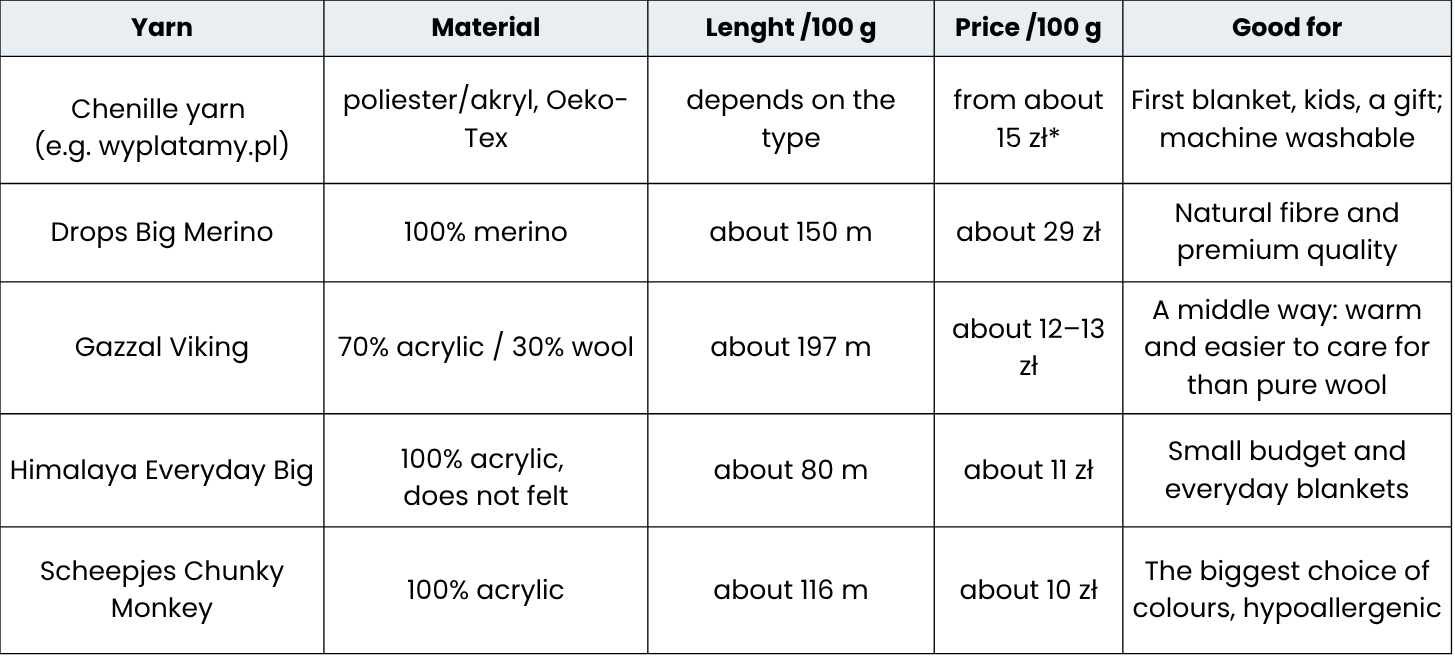
* a 230 g skein of standard chenille costs from 34 zł on sale at wyplatamy.pl.
How to care for a chunky blanket made from each type of yarn?
Wool and wool blends
With wool and wool blends, always follow the manufacturer's care instructions. Classic wool usually requires a "wool" or "delicate" cycle and a temperature of up to 30°C, but yarns marked as superwash may have different requirements — for example, Drops Big Merino can be machine washed on a delicate cycle at 40°C. Do not wring or rub the fabric, and set the spin speed according to the label. It is best to dry the blanket flat, away from direct heat sources.
Chenille and acrylic
Much less demanding: wash at up to 30–40°C on a delicate cycle (always check the label). Avoid tumble drying unless the label clearly allows it. The most common mistake: spinning too strongly "flattens" the textured chenille stitch and the blanket loses its fluffiness. A laundry bag is an inexpensive and effective form of protection.
Which yarn for a chunky blanket? Choose according to your priority
- Softness and light weight: chenille, especially in a gradient ombre version if you want an eye-catching pattern with little effort.
- Natural warmth and breathability: merino or alpaca — best for winter evenings and sensitive skin.
- Budget and durability: non-pilling acrylic or a wool-acrylic blend — a solid choice for everyday use.
- First blanket with no experience: super bulky chenille or acrylic with a starter kit — a quick start and reliable result.
FAQ: which yarn for a chunky blanket
Starter kits and the full yarn range at wyplatamy.pl
At wyplatamy.pl you will find standard and gradient chenille, loop yarns, marshmallow yarns (2 and 5 cm tube), and ready-made starter kits with instructions for a blanket project. The value of the kit is simple: you get the yarn, the project instructions, and the specified amount of material, so you do not have to calculate or guess anything. The effect of a handmade blanket is worth every minute spent choosing the material — and the first rows always look better than you think.


